Translation Disclaimer
Unless noted otherwise, ELAW’s Spanish- and French-language web pages have been automatically translated by Google Translate.

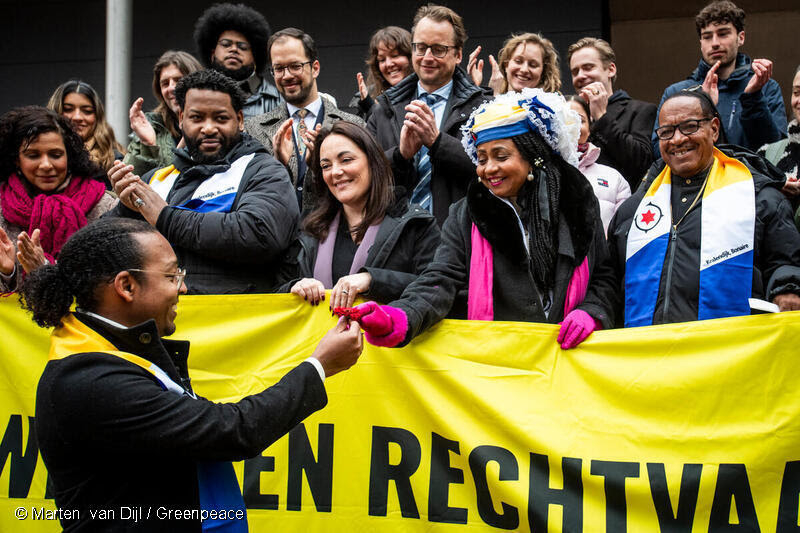
In January, the District Court of The Hague found the Dutch government had violated the human rights of residents of Bonaire by treating them differently from residents of European Netherlands when it comes to protecting them from climate change. The Court found this discrimination violates the European Convention on Human Rights (ECHR).
This is a monumental win for climate justice. By holding the Dutch State accountable for its obligations to citizens in its Caribbean territories, this ruling transforms “human rights” from a broad concept into a specific, enforceable mandate for climate action.
The residents of Bonaire already experience extreme heat, drought, flooding, and coral reef loss, while one-fifth of the island could disappear by the end of this century due to rising sea levels.
“ELAW’s Science Team provided useful references to support key points in the case,” says Maria Alejandra Serra, Legal Counsel Climate Justice and Liability – Climate Specialist at Greenpeace International.
This ruling signals to governments everywhere that climate policy is not a political choice—it is a legal obligation tied to the fundamental right to life and equality. Greenpeace Netherlands reports:
“The Dutch court is the first court in the world to rule that the State is discriminating against its own people by failing to develop and adopt a climate adaptation plan.”
The court found that the Dutch government is violating the ECHR in part by pursuing “a climate policy that does not make an equitable contribution to the measures that must be taken worldwide to limit global warming to a maximum of 1.5°C above pre-industrial levels by the end of this century” and by failing “to take timely and appropriate measures to protect the inhabitants of Bonaire from the effects of climate change and failing to adequately inform them about the consequences and involve them in decision-making on measures”; and by “treating the inhabitants of Bonaire differently from the inhabitants of the European Netherlands when taking adaptation measures, without that different treatment being appropriate, necessary and proportional.” Greenpeace Netherlands v. Netherlands, C/09/659832 / HA ZA 24-53 (28 January 2026) at 12.1 and 12.3 (unofficial English translation by the court).
To remedy this, the Court ordered the State to incorporate appropriate emission targets into legislation and to draft and implement an adaptation plan that covers Bonaire.
This decision adds to several recent judgments and opinions from international and regional courts, including the 2025 opinions from the International Court of Justice and the Inter-American Court of Human Rights, and the 2024 European Court of Human Rights KlimaSeniorinnen case.
Congratulations to all who worked to advance this tremendous victory!

Dr. Lalanath de Silva
Executive Director
Environmental Law Alliance Worldwide
Read More:
Greenpeace International. 26 January, 2026
The Netherlands violates human rights by failing to protect Bonaire residents from climate crisis: court
De Rechtspraak. 28 January, 2026
Dutch State insufficiently protects Bonaire inhabitants against climate change
Decision: Greenpeace Netherlands v. Netherlands, C/09/659832 / HA ZA 24-53 (English translation) (28 January 2026).